Users and plugin links
Find payload fields for user lifecycle and provider identity link events.
See the event catalogue for subscription triggers and Envelope and timing for the shared webhook fields.
User events
user.created, user.updated, and user.deleted carry a user profile with the fields below. user.deleted retains the profile captured before removal, including verified and verified_at.
| Group | Fields and wire types |
|---|---|
| Identity | unidy_id (UUID string), email, unconfirmed_email (strings or null). |
| Profile | first_name, last_name, salutation, gender, date_of_birth, company_name (strings or null; date of birth is a date). |
| Contact | phone_number, address_line_1, address_line_2, postal_code, city, country_code (strings or null). |
| Status | confirmed_at, verified_at (timestamps or null), verified (boolean). |
| Record timestamps | created_at, updated_at (timestamps). |
| Custom attributes | Additional keys merged directly into user, with values determined by each attribute's type. verified and verified_at remain reserved built-in fields. |
| Optional plugin data | plugins_data object when the receiving registration opts in. See below. |
{
  "unidy_id": "719791dc-da42-440f-a4e3-61292e9e6652",
  "email": "person@example.test",
  "unconfirmed_email": null,
  "first_name": "Alex",
  "last_name": "Example",
  "salutation": null,
  "gender": null,
  "date_of_birth": null,
  "company_name": null,
  "phone_number": null,
  "address_line_1": null,
  "address_line_2": null,
  "postal_code": null,
  "city": null,
  "country_code": null,
  "confirmed_at": "2026-10-01T12:00:00.000Z",
  "verified": false,
  "verified_at": null,
  "created_at": "2026-10-01T11:55:00.000Z",
  "updated_at": "2026-10-02T09:00:00.000Z"
}
This example is the user value; the envelope surrounds it. An email change can leave the current address in email and the pending address in unconfirmed_email. Use the current confirmed state, not an assumption that every update is an email change. Do not treat account confirmation as newsletter consent.
Custom attributes can contain personal or tenant-specific data. Verify the actual payload and approved fields before forwarding them. Do not assume the API-accessibility setting alone restricts this webhook's custom-attribute output.
For example, configured attributes can add "membership_number": "MEM-123", "vip_user": true, "birth_year": 2000, or a string description directly to user. Preserve their JSON types rather than moving these values into a new custom_attributes wrapper. These example names are not built-in fields available in every tenant.
Optional user.plugins_data
The registration's Include plugins data option affects ordinary user creation, update, and deletion events. Its value is an object with keys for the provider types available in that brand's plugin scope; provider identifiers may be null when the user is not linked.
{
  "eventim": { "tixx_id": "example-ticketing-id" },
  "hubspot": { "contact_id": 12345 },
  "plenigo": { "customer_id": 67890 },
  "campai": { "contact_id": "example-contact-id" }
}
The stored event may include this data because one matching registration requested it, while another registration receives the same event without user.plugins_data. The dashboard's stored Raw JSON therefore need not be identical to every outgoing body. Verify the body actually received, never a reconstructed dashboard copy.
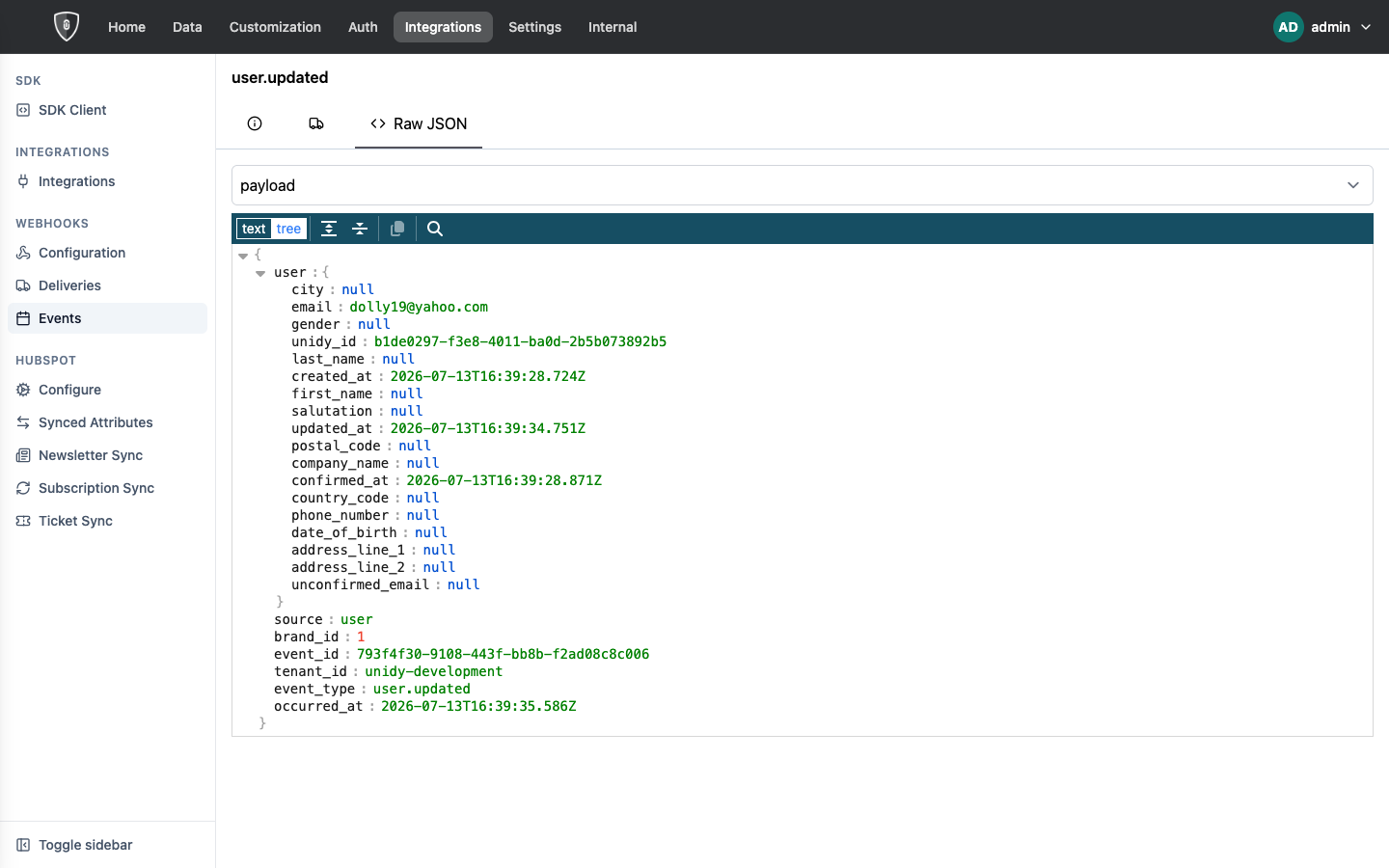
Integrations → Webhooks → Events → an event → Raw JSON — the stored payload for webhook event #12, the source of the example above.
Plugin-link events
user.plugin_connected and user.plugin_disconnected carry two top-level objects: user and plugin_data. They describe an explicit provider-identity link change, not every background synchronization with a provider.
The user object differs from the ordinary user-event shape:
| Group | Fields |
|---|---|
| Identity | id (the user's UUID), email, first_name, last_name, salutation, gender, date_of_birth, phone_number. The identifier is id, not unidy_id. |
| Address | address_line_1, address_line_2, city, postal_code, country_code, company_name. |
| Locale and scope | preferred_language; brands (array of brand names). |
| Status | verified, disabled (booleans); confirmed_at, verified_at, disabled_at, invitation_created_at, invitation_sent_at, invitation_accepted_at (timestamps or null). |
| Custom attributes | custom_attributes object containing API-accessible attributes; these are nested, not flattened into user. |
| Record timestamps | created_at, updated_at. |
plugin_data contains the affected link:
| Field | Type | Meaning |
|---|---|---|
type | string | Provider slug, for example eventim or campai. |
id | string or null | External provider identifier, serialized as a string to avoid numeric precision loss. |
connected_at | timestamp or null | Link row's creation time. It is not necessarily the most recent relinking time. |
For example, a connected event can include this top-level plugin_data value:
{
  "type": "eventim",
  "id": "2017916",
  "connected_at": "2026-10-02T09:00:00.000Z"
}
On disconnection the link data is captured for the event even if its backing record is removed. Interpret event_type to determine the action; do not infer that a non-null external ID means the link still exists. Top-level plugin_data is distinct from the optional user.plugins_data bundle and is not controlled by that opt-in option.