Webhooks overview
Understand events, registrations, and deliveries.
Receive notifications when users, newsletters, subscriptions, tickets, transactions, or connected accounts change in Unidy. Your service exposes an HTTPS endpoint; Unidy sends signed JSON requests to it.
Choose your guide
| Task | Guide |
|---|---|
| Register an endpoint, select events, or inspect activity in the dashboard | Webhook configuration |
| Build the receiver and handle signatures, retries, and duplicates | Configure and secure a webhook |
| Choose from the 23 event types and understand their payloads | Webhook event reference |
| Diagnose missing or failed requests and reconcile an outage | Troubleshoot failed deliveries |
The four webhook objects
| Object | Purpose |
|---|---|
| Registration | Your endpoint URL, signing secret, and delivery settings. |
| Subscription | An event type selected within a registration, with brands and a service where required. |
| Event | A stored event payload, shared by its matching subscriptions. |
| Delivery | One event/subscription pairing, with a stable delivery ID, attempt count, and latest response. A retry updates this delivery. |
A change can create several deliveries. Each delivery has its own UUID; all deliveries of the same event share its event_id. Optional plugin data can make outgoing user payloads differ between registrations.
Before you start
Have a reachable HTTPS endpoint and dashboard permissions to configure registrations and subscriptions. Read access alone does not grant permission to reveal or change secrets. Agree which event types, services, and brands the receiver needs.
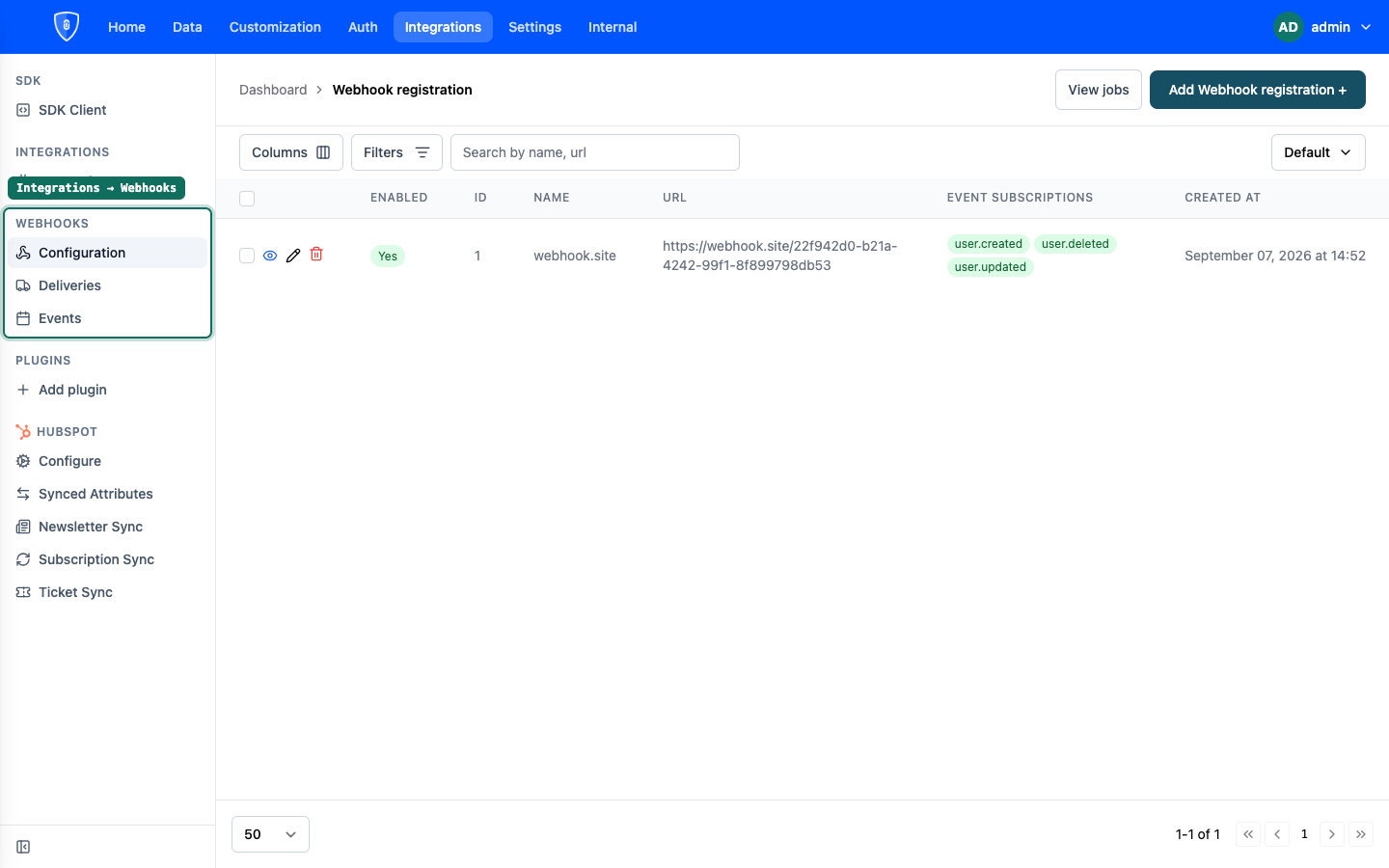
Configuration — the three webhook screens live under Integrations → Webhooks in the sidebar, in the order Configuration, Deliveries, Events · highlight on the sidebar group
New registrations use timestamped HMAC v2 signing. Existing registrations may use legacy v1; configure your receiver for the scheme selected on the registration.
Brand scope
When a dispatched event has no brand context, its brand_id is null and the subscription's brand filter is not applied. Brand selection is therefore not a complete isolation guarantee. Do not guess a brand from a null value or assume every payload contains enough information to recover it. If the receiver requires strict separation, resolve that requirement with your Unidy contact before enabling it. See subscription matching.
Delivery expectations
Requests can repeat and arrive out of order. Retries are bounded; successful delivery is not guaranteed. Persist accepted events before responding, process them idempotently, and monitor your receiver.
Use the REST API when you need current record state. It can help reconcile an outage, but current-state requests cannot recreate deleted records or every intermediate change. The recovery guide explains the available options.