Pagination and filtering
Work with collections and query parameters.
Use the pagination metadata returned by each endpoint, and use only the filters that endpoint supports. REST V1 collection formats, page-size defaults, and date precision vary by resource.
Endpoint reference
All paths below start with /api/v1. For paginated responses, results contains the current page and meta describes the matching collection.
| Endpoint | Envelope | Default / maximum limit | Supported filters |
|---|---|---|---|
GET /users | {meta, results} | 250 / 250 | Required changed_since; optional response expansion include_custom_attributes=true. |
GET /transactions | {meta, results} | 50 / 250 | user_id or user_email, category_id, channel, source_platform, external_id. |
GET /transactions/search | {meta, results} | 50 / 250 | The same transaction filters, plus required query. |
GET /users/{user_id}/transactions | {meta, results} | 50 / 250 | category_id, channel, source_platform, external_id; the path selects the user. |
GET /users/{user_id}/transactions/search | {meta, results} | 50 / 250 | The same per-user filters, plus required query. |
GET /newsletters, /transaction_categories, /custom_attribute_definitions | Resource-keyed arrays | Unpaginated | See the resource operation. The custom-definition response key is custom_attributes. |
| Ticket, subscription, and transaction line-item collections | Resource-keyed arrays | Unpaginated | See the resource operation and token requirements. |
Do not add page or limit to an unpaginated operation and assume the server will honor them. Budget for its complete response. Ticket and subscription routes also distinguish subject-bound user tokens from application-token routes under /users/{user_id}; see user-authorized access.
Read the pagination metadata
This illustrative response contains the first page of a filtered collection:
{
  "meta": {
    "count": 104,
    "page": 1,
    "limit": 50,
    "last": 3,
    "prev": null,
    "next": 2
  },
  "results": []
}
results is abbreviated here. Its actual length is at most meta.limit.
| Field | Meaning |
|---|---|
count | Total matching records when the query runs; not the length of this page. |
page | The page actually served. |
limit | The page size actually applied. |
last | Final page number. An empty collection still has page 1. |
prev, next | Adjacent page numbers, or null at the corresponding end. These are numbers, not URLs. |
Request page 1, process its results, then request the number in meta.next. Stop when meta.next is null. Preserve the filters and page size across requests.
curl --get 'https://your-tenant-host/api/v1/users' \
  -H 'Authorization: Bearer YOUR_ACCESS_TOKEN' \
  --data-urlencode 'changed_since=2026-09-01' \
  --data-urlencode 'limit=50' \
  --data-urlencode 'page=1'
A page below 1 is clamped to 1. A request past the final page returns the final page again, rather than an empty sentinel page. A loop that stops only when results is empty can therefore repeat indefinitely. Treat invalid or repeated meta.next values as a failed walk rather than silently advancing a checkpoint.
Choose a valid page size
Send an integer between 1 and 250. Inspect meta.limit rather than calculating offsets from the value you requested.
| Input | Users | Transaction lists and searches |
|---|---|---|
| Omitted | 250 | 50 |
| Above 250 | Clamped to 250 | Clamped to 250 |
| Zero or a negative integer | Invalid; can produce a server error | Clamped to 1 |
| Empty or nonnumeric | Invalid; can produce a server error | Defaults to 50 |
Validate page-size input in your own client. The users endpoint does not apply the same lower-bound handling as the transaction endpoints. Do not rely on malformed input being normalized consistently.
Filter users by change date
GET /users requires changed_since. Send an unambiguous YYYY-MM-DD value:
/api/v1/users?changed_since=2026-09-01&include_custom_attributes=trueThe filter compares updated_at with the start of that calendar date using a strict greater-than comparison. A timestamp supplied as the parameter loses its time component; 2026-09-01T16:30:00Z does not request changes since 16:30. Confirm the installation's date-boundary timezone when designing a sync.
Omitting the filter returns 400 with changed_since query parameter is required. An unparseable date returns 400 with invalid date format. Avoid locale-dependent date forms and epoch numbers.
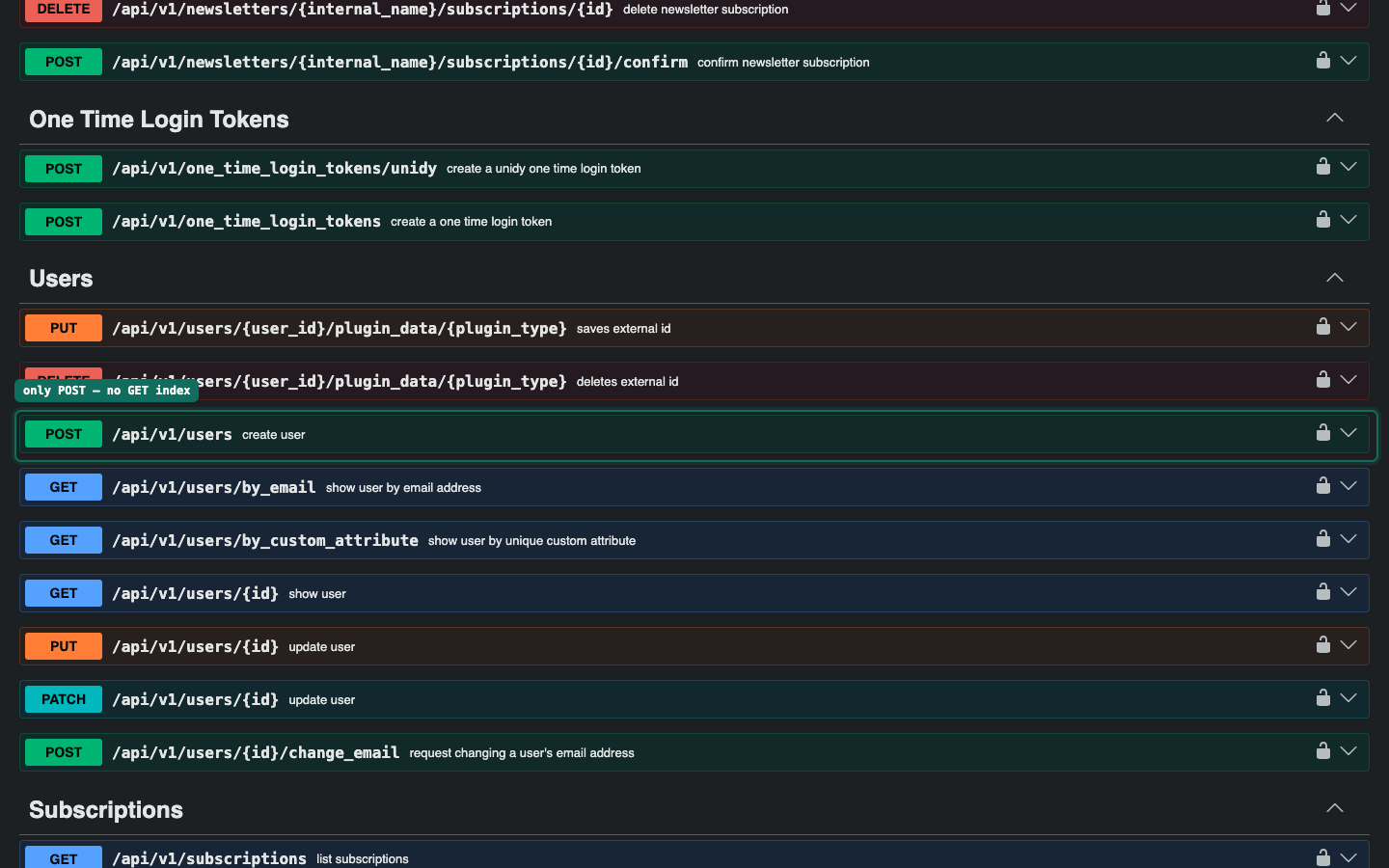
/SWAGGER/API/HTML — the whole Users section · highlight on POST /api/v1/users, the only operation on that path. There is no GET /api/v1/users row, so the list endpoint and its required filter are undocumented.
include_custom_attributes=true adds API-accessible custom attributes to each result. It changes the response, not the set of users matching the date filter. The key is omitted from list responses by default.
Date precision is endpoint-specific
The restricted translation endpoint uses updated_since with timestamp precision. That does not change the users endpoint's date-based contract. Neither changed_since nor updated_since is a supported transaction-list filter.
Filter transactions
The following filters apply to transaction list and search routes. Supported filters combine with AND, apart from the user_id / user_email precedence described below.
| Parameter | Value and behavior |
|---|---|
user_id | User UUID. Available on the top-level routes; takes precedence over user_email if both are supplied. |
user_email | Exact stored email match on top-level routes. Normalize the address before sending it. |
category_id | Legacy numeric category ID in this filter. It is not the category UUID used in transaction write bodies or returned by the category API. Do not substitute the UUID; use another supported filter if you do not have the numeric ID. |
channel | Exact match on the transaction's source_channel_id. A blank value does not filter for a null/empty channel. |
source_platform | Exact platform string; preserve its casing. |
external_id | Exact external transaction ID. This alone is not the transaction's complete business key. |
query | Required, nonblank search text on /search routes only. Matches supported searchable fields case-insensitively. |
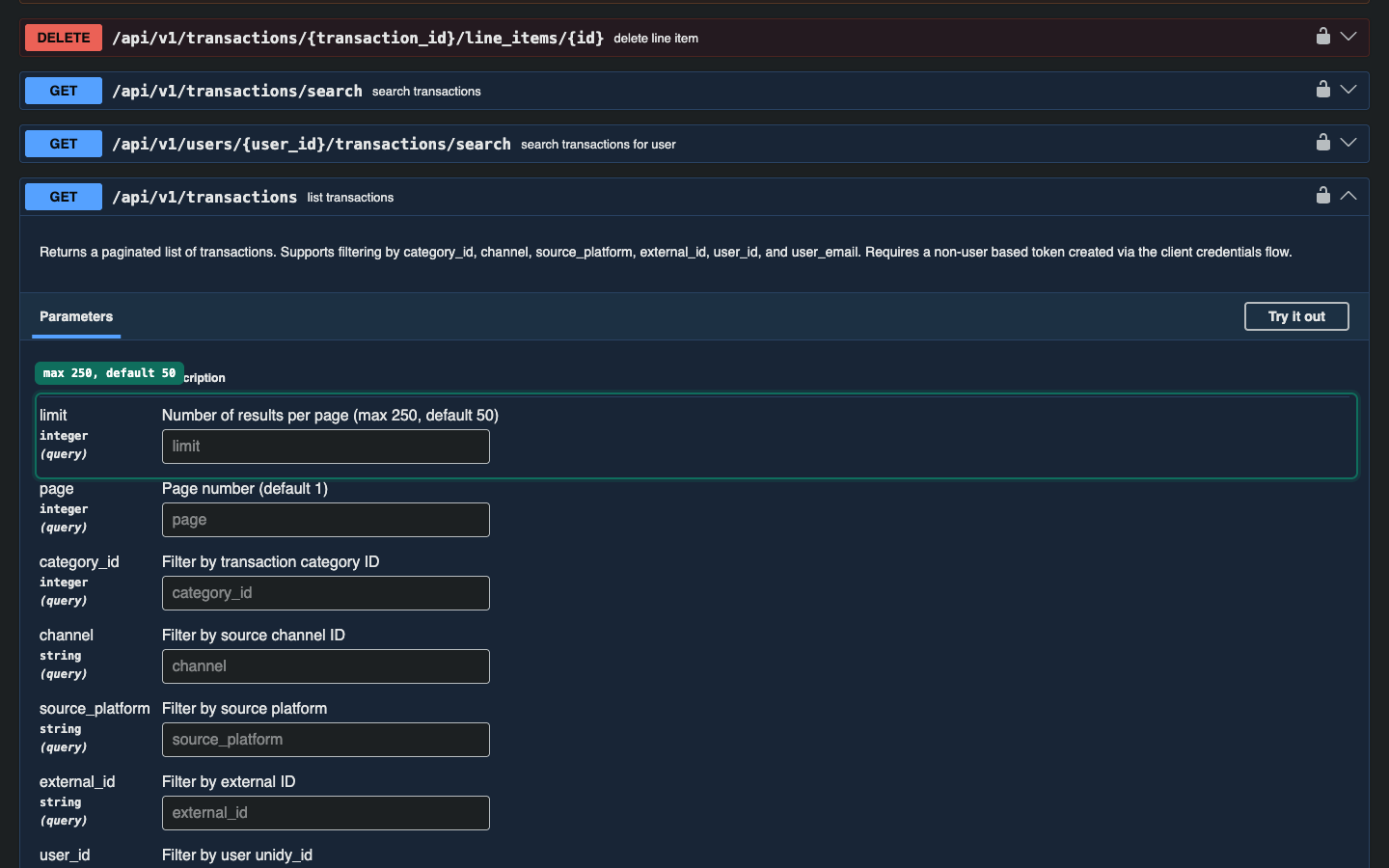
/SWAGGER/API/HTML — GET /api/v1/transactions expanded, showing all eight query parameters · highlight on the limit row, which states the 250 maximum and the default of 50.
On /users/{user_id}/transactions and its search route, the UUID in the path fixes the user. Adding a different user_id or user_email query parameter does not switch that scope.
For an exact transaction reconciliation, filter by external_id, source_platform, and a nonblank channel, then compare the full returned key and intended values. For a blank channel, filter by the first two fields and inspect the channel in each returned record. See common workflows.
Unsupported parameters may be ignored without a validation error. Use the names above and verify that returned records satisfy your intended predicate. A successful status or plausible total does not prove a filter was applied.
Ordering and synchronization limits
Users are paginated without a guaranteed ordering. Transactions are ordered by placed_at descending, without a guaranteed order between equal timestamps. Neither endpoint exposes a snapshot or stable cursor contract. Changes while an offset-based walk runs can move records between pages, producing duplicates or omissions.
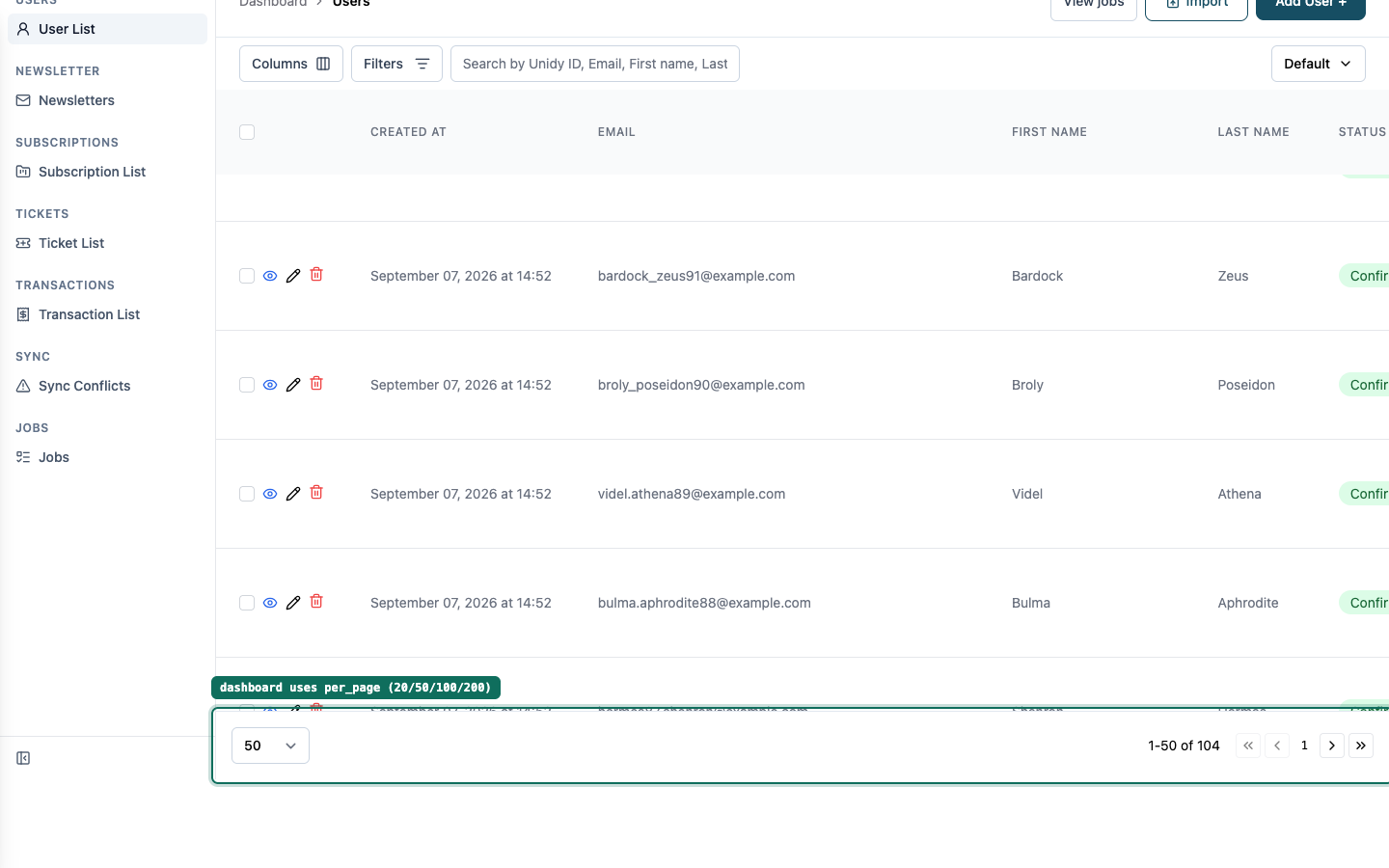
DASHBOARD → USERS → USER LIST — the paging footer · highlight on the Per Page control and the 1-50 of 104 range. The dashboard offers 20 / 50 / 100 / 200 and, above the table, sorting by any column — none of which exists on the API.
Deduplicating by ID prevents duplicate processing; it cannot recover an omitted record. Keeping only the first occurrence can also discard a newer version of that same ID. Reconcile each record's version using parsed updated_at timestamps and your destination's concurrency rules.
For a scheduled user sync:
- Persist an initial date and a last-completed-run checkpoint. Request a date earlier than the checkpoint using an overlap window suitable for your workload.
- Fix that request date for the whole walk. Start from page 1 and follow
meta.next. - Durably apply each record before considering that page processed. Compare versions per user ID; do not discard records merely because they are older than a global maximum timestamp.
- Commit the run checkpoint only after every page has been durably applied. Use the run's start time as the checkpoint, so the next run overlaps changes made during the walk.
- After a crash, restart the walk from the old checkpoint. Your writes must tolerate replay. Serialize competing sync runs or use a compare-and-swap checkpoint update.
- Use webhooks for prompt updates and deletions, and periodically reconcile the destination against source records. Retain failures for retry and investigation.
Overlap reduces exposure to changes around the boundary, but it does not make unordered offset pagination lossless. Neither a completed walk nor a maximum observed timestamp proves that every matching record was returned. Integrations requiring a guaranteed complete export need an agreed export or snapshot mechanism.
Common REST workflows gives a checkpoint sequence. Errors and retries covers request failures and safe replay.